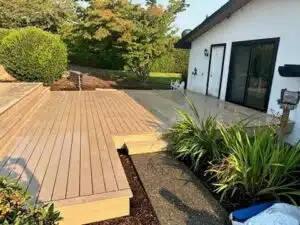
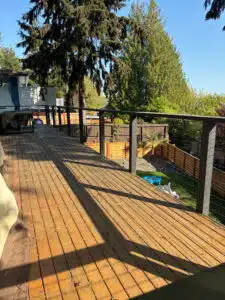
Trex decking costs about $5 to $17 per square foot for the boards alone and $28 to $65 per square foot installed in the Puget Sound area in 2026, depending on the line. Entry-level Trex Enhance sits at the low end. Trex Transcend, the line we install most often, typically runs $35 to $55 per square foot installed. A 400 sq ft Transcend deck in Bellevue with composite railing and removal of an old deck usually lands between $18,000 and $26,000 all-in.
Key takeaways
- The boards are only 25–35% of what you’ll pay. Framing, labor, railing, permits, and demolition are the rest.
- Any quote under about $15 per square foot is almost certainly materials only.
- Western Washington labor runs 15–25% above national averages, so national cost calculators will come in low.
- Trex warranties go from 25 years (Enhance) to 35 years (Select) to 50 years (Transcend, Lineage, Signature, and Refuge).
- Trex is usually a little cheaper than TimberTech at the same tier, and a little more expensive than Fiberon.
How much does Trex decking cost per square foot?
Here’s what each Trex line costs in 2026. The first price column is what the boards cost at a supplier. The second is what a finished deck costs per square foot in King and Pierce County, including framing, hidden fasteners, labor, and cleanup, but before railing, stairs, and permits.
Trex line | Boards only (per sq ft) | Installed, King & Pierce County (per sq ft) | Warranty | Best for |
|---|---|---|---|---|
Enhance Basics | $5–$6 | $28–$36 | 25 years | Tight budgets, ground-level decks |
Enhance Naturals | $5.50–$7 | $29–$38 | 25 years | The best look for the money |
Select | $6–$9 | $32–$42 | 35 years | Mid-range budgets, simple layouts |
Transcend | $9–$15 | $35–$55 | 50 years | Most Eastside family decks |
Transcend Lineage | $11–$15 | $40–$58 | 50 years | South- and west-facing decks in full sun |
Signature | $14–$17 | $45–$65 | 50 years | Premium builds, heavy use, pets |
Refuge (PVC) | around $15 | $45–$65 | 50 years | Lots that need a fire-rated deck |
Why Trex quotes are so far apart
If one contractor quotes you $9 a square foot for Trex Transcend and another quotes $45, they’re probably both telling the truth. The first number is materials. The second is a finished deck.
On our projects, the boards themselves come to roughly 25–35% of the total. The rest goes to the frame underneath, the fasteners, labor, railing, stairs, permits, and hauling away the old deck. When you compare bids, ask every contractor to itemize, and make sure each one is pricing the same scope. Our deck replacement cost guide walks through every line item you should expect to see.
Price per square foot vs price per linear foot
Suppliers sell Trex by the board, and some price lists quote per linear foot. That trips a lot of people up, because a linear-foot price looks about half as expensive as it really is.
A standard Trex board is 5.5 inches wide. With the 3/16-inch gap you leave between boards, each linear foot of board covers about 0.47 square feet of deck. So:
- A 12-foot board covers about 5.7 sq ft
- A 16-foot board covers about 7.6 sq ft
- A 20-foot board covers about 9.5 sq ft
To convert, multiply the price per square foot by 0.47 to get the price per linear foot, or divide a linear-foot price by 0.47 to get the square-foot price. Then add 10–15% for waste. More if you’re doing a picture-frame border or a diagonal layout.
What a Trex deck costs by size
These ranges cover the deck surface and framing, installed, in King and Pierce County. Railing, stairs, demolition, and permits are extra and covered below.
Deck size | Square feet | Trex Enhance, installed | Trex Transcend, installed |
|---|---|---|---|
12 × 12 | 144 | $4,000–$5,500 | $5,000–$7,900 |
12 × 16 | 192 | $5,400–$7,300 | $6,700–$10,600 |
16 × 20 | 320 | $9,000–$12,200 | $11,200–$17,600 |
20 × 20 | 400 | $11,200–$15,200 | $14,000–$22,000 |
For a real-world reference: a 400 sq ft Trex Transcend deck in Bellevue with composite railing, a standard layout, and demolition of the old deck typically runs $18,000 to $26,000 all-in. That includes labor, materials, permits, demo, and cleanup. The boards alone are roughly $3,200 to $5,200 of that.
Trex Enhance vs Select vs Transcend vs Lineage vs Signature
All Trex lines are capped composite boards. None of them need sanding, staining, or sealing. What you’re paying for as you move up is the thickness and toughness of the protective shell, how realistic the wood grain looks, heat performance, and warranty length.
Trex Enhance: the entry point
Enhance comes in two versions. Enhance Basics has a more uniform, solid color. Enhance Naturals adds a wood-grain pattern and multi-tonal colors for a small premium, and it’s the biggest visual jump per dollar in the whole Trex lineup. Enhance carries a 25-year warranty. It’s a good fit for ground-level decks, rentals, and anyone replacing pressure-treated wood on a budget. The honest trade-off: up close, it looks more like a painted board than hardwood.
Trex Select: the middle ground
Select steps up to a 35-year warranty and more color options. One detail most guides skip: Select boards are slightly thinner than the other Trex lines, and Trex says not to mix them with other lines on the same deck because of the tripping hazard. If you think you’ll want to extend the deck later in a different line, keep that in mind.
Trex Transcend: what we install most
Transcend is our most commonly specified product for standard Bellevue and Kirkland builds. It has a tougher shell with better scratch, fade, and stain resistance, deeper wood-grain colors, and a 50-year warranty. For a family deck that sees grills dragged across it, dogs, and patio furniture every week, the extra scratch resistance is where the money shows.
Trex Transcend Lineage: built for heat
Lineage is Transcend with heat-mitigating technology. Trex’s lab testing puts it up to 35°F cooler than its older boards. It also carries a 50-year warranty. In the Puget Sound, heat is less of a concern than in most of the country, but a south- or west-facing deck in July and August can still get uncomfortable for bare feet. That’s where Lineage earns its price.
Trex Signature: the top tier
Signature is Trex’s newest premium line and the one it rates as most scratch-resistant. It’s backed by a 50-year warranty. It makes sense for high-end builds, high-traffic decks, and households with large dogs. For most homeowners, Transcend delivers 90% of the benefit for less.
Trex Refuge: the fire-rated option
Refuge is Trex’s PVC line and the only one with a Class A flame spread rating. If your property sits in a wildland-urban interface zone, where local code may require ignition-resistant materials, this is the Trex line to ask about. It also carries a 50-year warranty.
What drives the installed cost of a Trex deck
Two decks with the same square footage and the same boards can differ by thousands of dollars. These are the factors that move the number most on our projects:
- Framing. Most Trex lines are rated for joists spaced 16 inches apart on a straight layout, and diagonal layouts usually need 12 inches. A lot of older Puget Sound decks were framed at 24 inches for wood decking, which means the frame needs reinforcing or rebuilding before composite goes down.
- Height and slope. Elevated decks and hillside lots, common across Bellevue and the Eastside, need taller posts, bigger footings, and more engineering. Expect $45–$70+ per square foot installed for elevated or sloped-lot builds.
- Demolition. Removing and hauling away an old deck typically adds $3–$8 per square foot.
- Railing. Composite and aluminum railing is priced per linear foot and can add several thousand dollars on a larger deck.
- Stairs. Each set of stairs adds framing, boards, and railing.
- Permits. In our area, permits typically run $500–$1,500.
- Layout. Picture-frame borders, diagonal boards, and curves add labor and waste.
- Access. Tight side yards and backyard-only access slow everything down.
Pacific Northwest factors national guides miss
Most Trex cost guides online use national averages. Here’s what’s different when you build in Western Washington.
Labor costs more. King and Pierce County labor rates run 15–25% above the national average. A national calculator will almost always come in low.
Permits are enforced. In most King County cities, a deck more than 30 inches above grade or attached to the house needs a permit. An unpermitted deck can cause problems when you sell and may not be covered by your homeowner’s insurance.
Shade and moisture matter more than heat. Decks under firs and cedars, on north-facing sides of the house, or close to the ground stay damp for much of the year. Capped composite won’t rot, but mildew can still grow on the surface and needs cleaning once or twice a year. For low, shaded decks with poor airflow underneath, a board capped on all four sides, or a PVC board with no wood fiber at all, is the safer choice.
The frame is what wears out first. The boards may carry a 50-year warranty, but the pressure-treated frame underneath is what fails in our rain. We protect the tops of joists and beams with flashing tape and make sure the ledger connection to the house is properly flashed. It adds little to the cost and a lot to the life of the deck.
Trex vs TimberTech vs Fiberon vs Deckorators
These are the four brands homeowners compare most. None of them is best across the board. It depends on your budget, where the deck sits, and what you want it to look like.
Brand | What it’s made of | Price vs Trex | Warranty range | Where it fits in the PNW |
|---|---|---|---|---|
Trex | Capped composite (plus Refuge PVC) | Baseline | 25–50 years | Best all-around value, widest color range, easy to source locally |
TimberTech | Capped composite (PRO, EDGE) and AZEK Advanced PVC | Slightly higher at the same tier; AZEK PVC is noticeably higher | 25–30 years on composite, longer on PVC | Low, shaded, or damp decks where a wood-free PVC board is worth paying for |
Fiberon | Capped composite and PVC | Usually about 10–15% lower at the same tier | Varies widely by line | Budget-conscious projects that still want a capped board |
Deckorators | Wood-composite and mineral-based composite | Similar to mid-to-premium Trex | Varies by line | Ground-level decks and spots with constant moisture |
Is TimberTech better than Trex?
Not better, different. TimberTech’s AZEK PVC boards contain no wood fiber, run cooler in darker colors, and carry longer warranties, which makes them a strong pick for low or shaded decks. Trex offers more colors, is easier to source, and costs less at comparable tiers. We install both, and for a standard Eastside deck that gets decent airflow, Trex Transcend is usually the better value. For a low deck under trees that never fully dries out, we often recommend TimberTech.
Is TimberTech cheaper than Trex?
Generally no. At comparable tiers, TimberTech composite runs slightly higher than Trex, and TimberTech AZEK PVC costs noticeably more because PVC is more expensive to make.
Is Fiberon as good as Trex?
Fiberon is a solid, competitively priced alternative. Its mid and premium lines compare well against Trex Select and Transcend, often for 10–15% less. The trade-off is that Trex is easier to find locally, which matters when you need matching boards for a repair or an addition years later.
Trex vs cedar: which costs less over time?
Cedar is cheaper up front. In King and Pierce County, a cedar deck typically runs $18–$28 per square foot installed, compared with $28–$55 for most Trex decks. But in our climate, cedar needs cleaning and restaining every two to three years to hold up against rain, moss, and UV, and even with good care it usually needs replacing after 15 to 20 years.
Trex needs a wash once or twice a year and nothing else. Over 20 to 25 years, once you add up the staining, repairs, and eventual replacement, Trex usually ends up costing about the same or less, with far less weekend work. If you’re planning to stay in your home for more than about eight to ten years, composite tends to win. Our decking material options guide compares cedar, composite, and PVC side by side.
Is Trex decking worth it? Pros and cons
Pros
- No sanding, staining, or sealing, ever
- Won’t rot, splinter, or attract insects
- 25- to 50-year warranties depending on the line
- Made with up to 95% recycled content
- Easy to source locally for future repairs and additions
Cons
- Costs more up front than cedar or pressure-treated wood
- Dark colors get hot in direct summer sun
- Mildew can still grow on the surface of shaded decks and needs cleaning
- Deep scratches can’t be sanded out like wood
- Entry-level lines look less like real wood up close
For most Puget Sound homeowners who plan to stay put for a while, Trex is worth it. The exceptions are short-term ownership, where cedar’s lower upfront cost makes more sense, and very low, damp decks, where PVC is the better investment.
Does Trex decking get hot?
Yes, like any composite or wood deck, Trex absorbs heat in direct sun, and darker colors get hotter than lighter ones. Trex Transcend Lineage is designed to stay significantly cooler. Around here, it’s really only an issue on south- and west-facing decks during July and August. If that describes your deck, choose a lighter color or go with Lineage.
Choosing a Trex color
Color affects more than looks. Lighter greys and sandy tones stay cooler in the sun and hide fading better, but they show pollen and dirt faster during our long spring. Darker browns look rich and hide dirt, but they hold heat. The best way to decide is to order free samples from Trex and look at them on your own deck at different times of day. Showroom lighting can be misleading.
How to get an accurate Trex deck quote
- Ask for an itemized quote: boards, framing, fasteners, railing, stairs, demolition, permits, and cleanup as separate lines.
- Confirm which Trex line and color are being quoted. Enhance and Transcend can look similar in a photo and differ by thousands of dollars.
- Ask whether the existing frame will be reused, reinforced, or replaced, and why.
- Confirm the contractor pulls the permit.
- Get the workmanship warranty in writing, separate from the Trex product warranty.
If you’re still vetting contractors, our guide on how to choose a deck replacement contractor covers the questions worth asking.
Get a real Trex price for your deck
Every deck is different, and the only way to know what yours will cost is to have someone look at the site. We give free, itemized estimates across King and Pierce County, and we handle design, permits, demolition, and installation. See our deck building services, or check the local details for Bellevue and Kirkland.
FAQs — Trex Decking Cost

How much does a Trex deck cost in 2026?
In the Puget Sound area, a Trex deck costs $28 to $65 per square foot installed, depending on the line. A 320 sq ft (16 × 20) deck runs about $9,000 to $12,200 in Trex Enhance or $11,200 to $17,600 in Trex Transcend, before railing, stairs, demolition, and permits.
How much is Trex per square foot?
Trex boards cost about $5 to $17 per square foot depending on the line, from Enhance Basics at the low end to Signature at the top. Installed with framing and labor, expect $28 to $65 per square foot in King and Pierce County.
Is Trex cheaper than TimberTech?
Usually, yes. At comparable tiers, Trex composite costs slightly less than TimberTech composite, and noticeably less than TimberTech AZEK PVC.
What's the difference between Trex Enhance, Select, and Transcend?
Enhance is the entry line with a 25-year warranty. Select is the mid-range line with a 35-year warranty and slightly thinner boards. Transcend is the premium line with a tougher shell, better scratch resistance, richer colors, and a 50-year warranty.
How much does it cost to replace a wood deck with Trex?
Plan on the installed Trex cost plus $3 to $8 per square foot to remove the old deck. If the existing frame is sound and spaced at 16 inches, it can sometimes be reused, which saves money. Many older decks were framed at 24 inches and need reinforcing first.
Does Trex decking get hot?
Yes, especially darker colors in direct sun. Trex Transcend Lineage uses heat-mitigating technology designed to stay much cooler. In the Pacific Northwest, heat is mainly a concern on south- and west-facing decks in mid-summer.
Do I need a permit for a Trex deck in King County?
In most King County cities, decks more than 30 inches above grade or attached to the house need a permit. Permits typically cost $500 to $1,500. A professional contractor should pull the permit and schedule inspections for you.
How long does a Trex deck last?
Trex boards are warranted for 25 to 50 years depending on the line. In practice, the pressure-treated frame underneath is usually what limits a deck’s life in our climate, which is why proper flashing and joist protection matter.
Can you install Trex over an existing deck frame?
Sometimes. The frame has to be structurally sound and have joists spaced 16 inches apart or closer for a standard straight layout. We inspect every frame before quoting, because putting new boards on a failing frame just moves the problem.
Is Trex decking worth it in the Pacific Northwest?
For most homeowners, yes. Trex handles rain and moisture far better than wood and never needs staining. On very low, shaded decks that stay damp year-round, a wood-free PVC board can be the better choice.