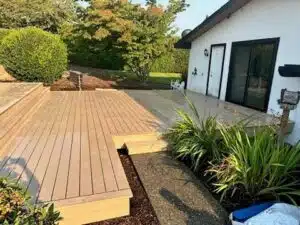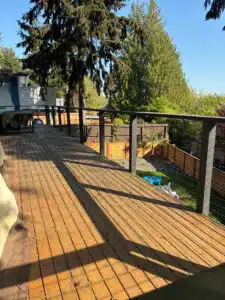
The best decking material for your home depends on three things: how much moisture your site gets, how much maintenance you’re willing to do, and what you’re spending over a 20-year horizon — not just upfront.
Choosing a decking material is one of the most consequential decisions in any deck project. It determines how long the deck lasts, how much you spend maintaining it, how it performs in Western Washington’s wet winters and UV summers, and what it looks like a decade from now. Get it right and you’re done for 25–30 years. Get it wrong and you’re back to square one in eight.
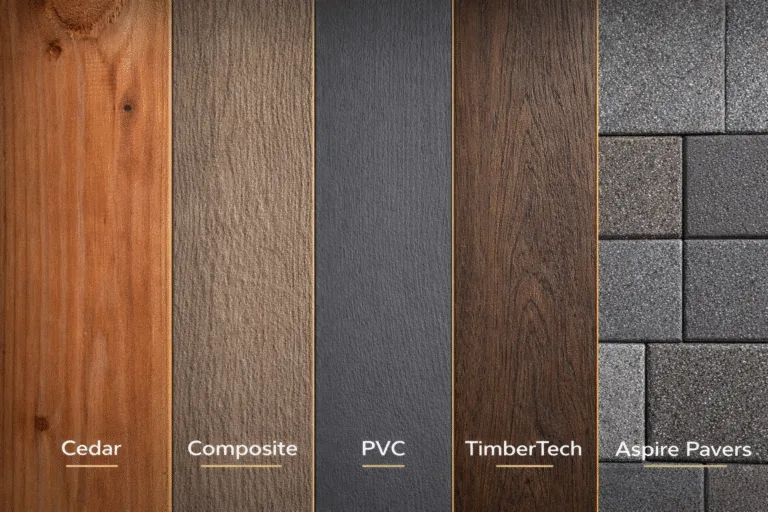
This guide covers every major decking material available in 2026 — cedar, composite, PVC, Trex, TimberTech, and Aspire Pavers — with honest performance data, maintenance expectations, and cost ranges specific to King and Pierce County. No filler, no generic advice. Just the information you need to make the right call for your specific situation.
Quick Comparison — All Materials Side by Side
Before going deep on each option, here’s how every material stacks up across the metrics that matter most for Pacific Northwest decks.
| Material | Lifespan | Maintenance | PNW moisture | Upfront cost | Best for |
|---|---|---|---|---|---|
| Western red cedar | 15–25 yrs | High — seal every 2 yrs | Moderate | $ | Classic look, budget builds |
| Composite (generic) | 20–30 yrs | Low — annual cleaning | Good | $$ | Mid-range durability + value |
| Trex | 25 yrs+ | Very low | Excellent | $$ | Best-selling composite, wide range |
| TimberTech | 25–50 yrs | Very low | Excellent | $$$ | Premium finish, sloped/elevated builds |
| PVC | 30–50 yrs | Minimal | Excellent | $$$ | Waterfront, high-moisture sites |
| Aspire Pavers (Brava) | 25+ yrs | Very low | Excellent | $$$ | Ground-level, modern aesthetic |
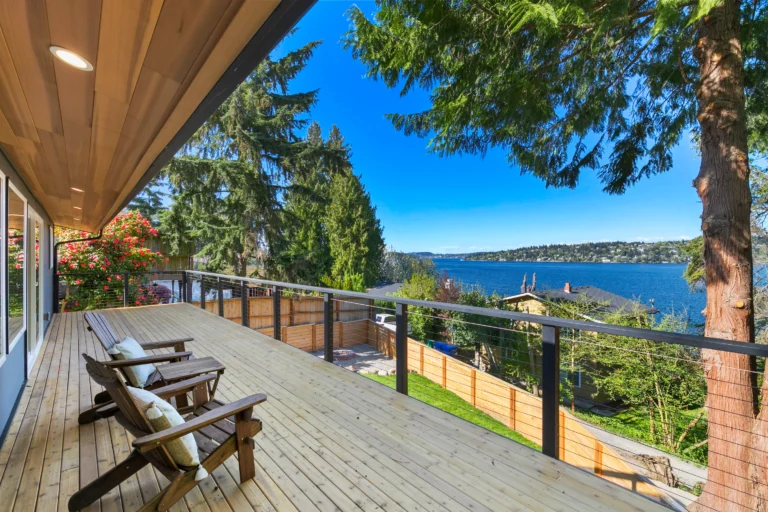
Cedar Wood Decking : Classic Look, Real Maintenance Commitment
Western Red Cedar
The traditional Pacific Northwest choice — beautiful, workable, and demanding.
- Lifespan: 15–25 years
- Maintenance: Seal every 2 yrs
- Cost range: $18–$28/sq ft installed
Western red cedar has been the default deck material in the Pacific Northwest for decades — and for good reason. It’s locally sourced, naturally resistant to insects and rot compared to untreated softwoods, easy to cut and fasten, and produces the warm, authentic wood look that many homeowners want. When properly maintained, a cedar deck is genuinely beautiful.
The honest caveat: “properly maintained” is doing real work in that sentence. In King and Pierce County’s wet climate, an unsealed cedar deck can start showing moss growth and gray discoloration within two years. Without regular sealing or staining — every 1–2 years, not every 5 — the wood absorbs moisture, the grain opens up, and rot begins in the places you can’t see: the underside of boards, the end grain, anywhere water pools.
Cedar is a legitimate choice if you enjoy the maintenance ritual and want natural wood. It’s the wrong choice if you’re comparing it to composite on a 15-year cost basis — by the time you add up sealing, cleaning, and board replacement, cedar’s “lower upfront cost” often disappears.
Best for homeowners who want natural wood, are comfortable with biannual maintenance, and are building on a drier, well-drained site. Not recommended for waterfront properties, under-canopy builds, or north-facing decks with chronic shade and moisture — particularly on wooded hillside lots in Sammamish where deep canopy makes cedar a poor long-term investment.
If you already have a cedar deck showing signs of aging — soft spots, gray discoloration, or board cupping — our guide to common deck problems homeowners ignore covers exactly what those signs mean structurally and when cedar repair crosses into replacement territory. Our repair vs. replace guide walks through the financial decision framework in detail.
Composite Decking — The Most Popular Choice in King County
Composite Decking (Capped)
Wood fiber and recycled plastic — engineered for low maintenance and Pacific Northwest durability.
- Lifespan: 20–30+ years
- Maintenance: Annual cleaning only
- Cost range: $28–$45/sq ft installed
Composite decking — a blend of wood fiber and recycled plastic with a protective polymer cap — has become the dominant choice for deck replacements throughout King County, and it’s not hard to understand why. It doesn’t rot, doesn’t absorb moisture, doesn’t need staining or sealing, and holds its color and texture over decades of Western Washington weather. For busy homeowners who want a deck they can enjoy rather than maintain, composite is usually the right answer.
The key distinction within composite is capped vs. uncapped. Uncapped composite has an exposed wood-fiber core that can absorb moisture and develop mold — not ideal in our climate. Always specify fully capped composite boards (polymer shell on all four sides), which is what both Trex and TimberTech produce. An uncapped composite board priced attractively is false economy in the PNW.
The best balance of cost, performance, and maintenance for most King and Pierce County homeowners. Specify fully capped boards — both Trex and TimberTech qualify. Uncapped composite is not recommended for Western Washington conditions.
Trex — The Best-Selling Composite Brand, Honestly Evaluated
Trex Composite Decking
The most widely installed composite brand in North America — and in most of our King County projects.
- Warranty: 25 years
- Maintenance: Annual cleaning
- Cost range: $28–$38/sq ft installed
Trex is the composite brand most of our clients have already researched before they call us — and it’s earned that recognition. All Trex boards are fully capped, fade- and stain-resistant, and carry a 25-year limited warranty. The product line runs from Trex Select (entry-level) through Trex Transcend (premium), giving homeowners genuine options at different price points without sacrificing the core performance.
In Pacific Northwest conditions specifically, Trex performs very well. The capped surface resists moss adhesion better than open-grain wood, and the boards don’t absorb the moisture that drives rot and warping in cedar. The main limitation is heat retention — darker Trex colors absorb more sun and can feel warm underfoot during Seattle’s summer stretches. Lighter color families or lighter composite options from TimberTech address this if it’s a concern.
Trex Transcend in Gravel Path and Spiced Rum are our most commonly specified colors in Bellevue and Eastside builds — they read warm without absorbing excessive heat and hold up exceptionally well under the tree canopy coverage common in Eastside lots.
Reliable, well-warranted, and competitively priced. The right choice for most composite builds in our service area. For detailed pricing by board grade, see our Trex decking cost guide.
TimberTech — Premium Composite for Demanding Builds
TimberTech Decking
Advanced capping technology, superior moisture resistance — our recommendation for elevated and sloped-lot builds.
- Warranty: Up to 50 years
- Maintenance: Very low
- Cost range: $35–$50/sq ft installed
TimberTech sits at the premium end of the composite market — and it earns it. The AZEK-owned brand offers the most comprehensive capping technology available, with a full polymer shell that virtually eliminates moisture absorption. In our climate, where composite boards can face sustained moisture exposure for 6+ months per year, that difference in capping performance matters over a 20-year horizon.
TimberTech’s top-tier lines — AZEK and Vintage — also offer the most realistic wood-grain aesthetics currently available in composite. If you’re replacing a cedar deck and concerned about losing the natural look, TimberTech closes that gap more convincingly than any other product we install. The warranty (up to 50 years on some product lines) reflects genuine confidence in the manufacturing — it’s not marketing language.
Where we most frequently specify TimberTech: elevated builds on Bellevue’s hillside lots where moisture exposure is highest, sloped properties where drainage is a chronic challenge, and projects where the homeowner wants premium aesthetics with a genuinely long replacement cycle.
The best-performing composite product for challenging Pacific Northwest sites. Higher upfront cost is justified on elevated builds, waterfront-adjacent properties, or any installation with above-average moisture exposure. Worth the premium if you’re building once and not touching it again for 30+ years.
PVC Decking — Maximum Moisture Resistance
PVC Decking
100% synthetic — zero wood fiber, zero moisture absorption, zero rot risk.
- Lifespan: 30–50+ years
- Maintenance: Minimal
- Cost range: $38–$55/sq ft installed
PVC decking contains no wood fiber whatsoever — it’s a 100% synthetic polymer product. That means it cannot absorb moisture, cannot rot, cannot support moss or mold growth at the board level, and is not affected by insects. In Pacific Northwest conditions, those are meaningful advantages, particularly for installations with chronic moisture exposure: covered decks, north-facing decks that rarely dry out, or any structure near water.
The trade-offs are real. PVC boards expand and contract more than composite in temperature swings, which requires specific installation techniques (hidden fastener systems with appropriate spacing). Darker PVC colors can retain significant heat in direct sun — more than composite in some product lines. And the upfront cost is the highest of any decking category.
Where PVC makes the most sense in our service area: Lake Tapps waterfront properties, covered outdoor structures where composite’s UV resistance isn’t relevant but moisture performance is, and north-facing or heavily shaded builds where chronic dampness would stress even capped composite.
The right choice for maximum moisture resistance — particularly waterfront, covered, and chronically shaded installations. Not necessary for standard exposed decks in Bellevue or Seattle where capped composite performs excellently. Worth the premium when site conditions demand it.
Aspire Pavers by Brava — The Alternative Worth Knowing
Aspire Composite Pavers by Brava
95% recycled materials, slip-resistant, and uniquely suited to ground-level installations.
- Material: Recycled rubber + plastics
- Maintenance: Very low
- Cost range: $35–$50/sq ft installed
Aspire Pavers are different from every other product on this list — they’re not boards, they’re interlocking pavers made from 95% recycled rubber and plastic. As a preferred Aspire by Brava contractor, we install these primarily for ground-level applications and rooftop deck surfaces where the installation format is an advantage: individual pavers can be lifted for access to drainage or utilities underneath, and replaced individually if damaged rather than requiring board-level replacement.
The slip-resistance is genuinely superior to most composite boards — the rubber-dominant surface maintains traction when wet in a way that smooth polymer composites don’t. For households with children, pets, or older adults using the deck frequently, that’s a meaningful safety advantage in a climate that keeps deck surfaces wet for half the year.
Where Aspire doesn’t make sense: elevated or framed deck builds where traditional board-and-joist construction is structurally required. These are a ground-level or flat-surface product.
A genuinely strong option for ground-level patios, rooftop decks, and surfaces where slip resistance and access-under-surface are priorities. Not a substitute for framed deck construction on elevated builds.
How to Choose the Right Material for Your Specific Situation
The comparison table is useful for orientation, but the real decision comes down to your specific site and situation. Here’s how to think through it:
You want natural wood and will maintain it
Western red cedar. Budget for biannual sealing. Use corrosion-resistant hardware. Plan on 15–20 years with good maintenance.
You want low maintenance and reliable performance
Trex Transcend or TimberTech AZEK. Both are fully capped, fade-resistant, and warrantied for 25+ years. Trex is the value option, TimberTech is the premium.
Your site has chronic moisture — waterfront, heavy shade, north-facing
PVC or TimberTech. These are the products designed for maximum moisture resistance. Don’t install uncapped composite or cedar in these conditions.
This includes hillside lots in Renton’s Highlands and Talbot Hill, where north-facing exposure and sustained moisture put these builds firmly in AZEK or PVC territory.
Ground-level patio or rooftop surface
Aspire Pavers by Brava — particularly if slip resistance and under-surface access matter. More installation flexibility than boards for flat applications.
You’re replacing an existing cedar deck
First determine if the framing is sound. If it is, composite boards can often go on the existing frame — check our repair vs. replace guide to understand when that works and when full replacement is the right call.
Budget is the primary constraint
Cedar upfront, but run the 15-year math first — maintenance costs narrow the gap significantly. If composite is within reach, it usually wins on total cost of ownership over a decade.
What Decking Materials Cost in King & Pierce County (2026)
These are installed cost ranges — labor, materials, and standard hardware included — for licensed, permitted projects in our service area. They do not include demolition of an existing deck ($3–$8/sq ft) or permit fees ($500–$1,500 depending on scope).
| Material | Installed cost range | 20-yr maintenance estimate | Total 20-yr cost* |
|---|---|---|---|
| Cedar | $18–$28/sq ft | $3,000–$6,000 (400 sq ft deck) | Moderate-high |
| Composite (Trex) | $28–$38/sq ft | $400–$800 | Moderate |
| TimberTech | $35–$50/sq ft | $400–$800 | Moderate-high upfront, low long-term |
| PVC | $38–$55/sq ft | $200–$400 | High upfront, lowest long-term |
| Aspire Pavers | $35–$50/sq ft | $200–$400 | High upfront, lowest long-term |
*Total cost estimates are indicative for a 400 sq ft deck over 20 years and vary significantly by project complexity.
For a full breakdown of what drives deck replacement pricing in our market — including demolition, permits, railing costs, and complexity factors — our deck replacement cost guide covers every variable in detail.
When you’re ready to move forward, working with an experienced deck replacement contractor who specifies the right material for your site — not just whatever they have in stock — is the single biggest factor in getting a deck that performs for 25+ years in Pacific Northwest conditions.
Not sure which material is right for your project?
Orca Roofing & Exteriors installs all six materials covered in this guide across King and Pierce County. We assess your site conditions — slope, moisture exposure, sun, drainage — before recommending anything. Request a free consultation →
If you’re in the South Sound area, our Tacoma deck team can assess your specific site conditions and recommend the right material for your lot.
FAQs — Best Decking Material for Pacific Northwest Homes
Which decking material lasts the longest in Western Washington?
PVC and fully capped composite (TimberTech AZEK) deliver the longest lifespans in Pacific Northwest conditions — 30–50 years with minimal maintenance. Cedar, properly maintained, runs 15–25 years. The key variable in our climate isn’t just the surface material — it’s the hardware and framing underneath. Corrosion-resistant hardware rated for ground contact is essential regardless of what decking material goes on top.
Is composite decking worth the extra cost over cedar in the PNW?
In most cases, yes — when you run the full 15-year cost including sealing, cleaning, and board replacement. A 400 sq ft cedar deck can cost $3,000–$6,000 more to maintain over 15 years than composite. The upfront premium for composite typically pays back within 8–10 years on a standard King County build. The exception: if you genuinely want natural wood and will commit to the maintenance, cedar is a legitimate choice.
Is Trex or TimberTech better for Bellevue and Eastside properties?
Both are excellent products. Trex is the better value for standard builds — competitively priced, 25-year warranty, proven performance in our climate. TimberTech’s AZEK and Vintage lines are worth the premium on elevated builds, sloped lots, or any installation with above-average moisture exposure — the advanced capping holds up better in those conditions over a 20+ year horizon. For most standard Bellevue builds, Trex Transcend is our most commonly specified product.
Can I replace just the surface boards on my existing deck rather than rebuilding the whole thing?
- Yes — if the structural framing (joists, beams, ledger, posts) is in sound condition. A full structural inspection is essential before assuming the frame is reusable. If the framing shows rot or moisture damage, board replacement on a compromised frame is money spent on a structure that still needs full replacement. Our repair vs. replace guide covers the inspection checklist and financial decision framework in detail.
What decking material is best for waterfront homes in Lake Tapps or Mercer Island?
PVC or TimberTech AZEK. Waterfront sites have sustained high moisture exposure that stresses even good-quality composite products over time. PVC’s zero wood-fiber content means zero moisture absorption — it’s purpose-built for these conditions. TimberTech AZEK’s advanced capping provides the next-best moisture resistance if aesthetics are a priority.
How do I know if my existing deck needs replacement or just repairs?
Check the structural framing — not just the surface boards. Press a screwdriver into joists, post bases, and the ledger board. If it sinks more than a quarter inch without resistance, the wood is structurally compromised. Visible soft spots underfoot, wobbly railings, or gaps at the ledger-to-house connection are also red flags. Our guide to common deck problems covers every warning sign in detail.