A cedar shake roof lasts about 20 to 30 years in the Pacific Northwest, shorter than the 30 to 40 years quoted nationally, because our rain and tree cover keep it damp for much of the year. If yours is under 20 years old and the problems are isolated, repair it. If it’s past 25, has moss established across the field, or shows curling and splitting on more than one slope, you’re choosing between new cedar and composite. Most homeowners here who liked the look but were tired of the upkeep end up switching to composite.
Key takeaways
- Cedar needs real maintenance here: cleaning and treatment every two to three years, not optional.
- Moss is the main enemy. It holds water against the shake and accelerates rot from underneath.
- Curling, splitting and cupping are age. Moss and a few missing shakes are maintenance.
- North-facing slopes under trees fail first, often a decade before south-facing ones.
- Pressure washing a cedar roof shortens its life. It’s the single most common mistake.
How long does a cedar shake roof last in the Pacific Northwest?
Nationally you’ll see 30 to 40 years quoted for cedar shake. Here, plan on 20 to 30 years, and closer to 20 if the roof is shaded, under tree cover, or has gone without maintenance.
The difference is moisture. Cedar is naturally rot-resistant, not rot-proof. What it resists is occasional wetting followed by drying out. What it doesn’t resist is staying damp for eight months a year, which is exactly what happens on a north-facing slope under a fir in Bellevue or on a shaded Tacoma craftsman.
Condition | Realistic lifespan here |
|---|---|
Open, sunny exposure, maintained every 2–3 years | 28–35 years |
Typical suburban lot, some tree cover, occasional maintenance | 22–28 years |
Shaded or north-facing, heavy tree cover, maintained | 18–25 years |
Shaded, never maintained, moss established | 15–20 years |
It’s common for one slope of the same roof to be in good shape while another is failing. We see roofs where the south side has another decade and the north side is done.
Shakes vs shingles: not the same thing
Cedar shakes are split, thicker, and have a rough, irregular texture. Cedar shingles are sawn, thinner, and lie flatter with a uniform look. Shakes generally last longer because of the thickness; shingles give a cleaner line. Most of the older cedar roofs in this region are shakes.
Signs your cedar roof is failing
Age, not maintenance — start planning a replacement:
- Curling or cupping. Shakes lifting at the edges. Water gets underneath and the fasteners loosen.
- Splitting across the grain. Normal splits run with the grain; cross-grain splits mean the wood is spent.
- Thinning and erosion. Shakes noticeably thinner than when installed, with a soft, fibrous surface.
- Widespread broken or missing shakes. A few is a repair. Dozens across multiple slopes is a roof.
- Soft spots underfoot or any sag. That’s decking, and it changes the conversation entirely.
Maintenance, not age — fixable:
- Moss and lichen on the surface
- Debris packed in the keyways between shakes
- A handful of cracked or slipped shakes
- Failing flashing at a chimney or valley
- Dark staining with the shakes still solid underneath
The moss problem
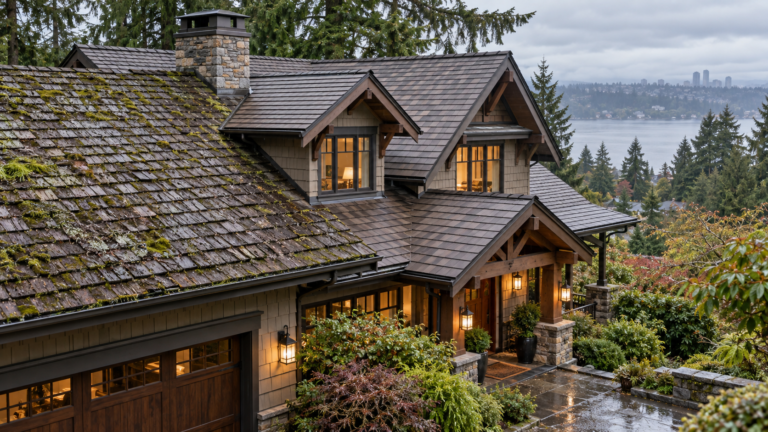
Moss is the single biggest factor in how long a cedar roof lasts here, and it’s badly misunderstood.
Moss doesn’t eat cedar. What it does is hold water against the wood and in the keyways, so the shake never dries out. Cedar that stays wet rots from the underside, where you can’t see it. By the time moss is visibly thick, the damage underneath is often already done.
What helps: keeping the roof clear of needles and leaves, trimming branches back so the roof gets light and airflow, zinc or copper strips at the ridge, and professional cleaning with treatment every two to three years.
What hurts: pressure washing. It strips the weathered surface layer that protects the shake, drives water underneath, and can loosen fasteners. It makes a roof look dramatically better and takes years off its life. If a cleaning company quotes you pressure washing for a cedar roof, that is the signal to call someone else.
Cedar shake roof maintenance: what it actually involves
- Clear debris twice a year. Autumn after the leaves drop, and spring. Needles packed in the keyways are where rot starts.
- Keep branches trimmed back. Light and airflow do more for a cedar roof than any product.
- Clean and treat every 2–3 years. Gentle cleaning, then a treatment. Not pressure washing.
- Keep gutters flowing. Backed-up gutters keep the lowest course permanently wet.
- Replace broken shakes as you notice them. One broken shake is a cheap fix; the leak it causes is not.
- Inspect flashing annually. Chimneys, valleys and skylights fail before the field of the roof does.
Honest framing: a cedar roof is a maintained roof. If that upkeep isn’t going to happen, cedar is the wrong material and you’ll pay for it in a shortened lifespan.
Repair or replace?
Situation | What makes sense |
|---|---|
Under 15 years, isolated damage | Repair. Replace shakes, fix the flashing. |
15–20 years, moss but shakes solid | Clean and treat. You may buy several more years. |
20–25 years, curling on one slope | Partial replacement is possible but rarely economical. Get both options priced. |
Over 25 years, curling or splitting across slopes | Replace. Repairs at this stage are money spent twice. |
Any age, soft decking | Replace, and budget for decking work. |
The economics that catch people out: cedar repairs are labor-intensive and matching weathered shakes is difficult, so repairs cost more per square foot than people expect. [VALIDAR: rango tipico de reparacion de Orca] Once you’re spending a meaningful fraction of a replacement on repairs to a roof past 25, you’re funding the problem rather than solving it.
Our guide on roof repair vs replacement covers the general decision framework.
Replacing cedar: new cedar or composite?
This is the real decision for most homeowners here, and it isn’t about which product is better. It’s about whether you want to maintain a roof.
New cedar shake | Composite cedar-look | |
|---|---|---|
Appearance | The real thing, weathers to silver-grey | Very close from the street; some can tell up close |
Lifespan here | 20–30 years with maintenance | 50+ years |
Maintenance | Clean and treat every 2–3 years | Clear debris; no treatment |
Moss | Shortens the roof’s life | Grows on the surface, doesn’t damage the tile |
Fire rating | Varies; treated options available | Class A available |
Weight | Moderate | Light, no structural reinforcement needed |
Choose new cedar if: the authenticity matters to you, you have a historic or design-reviewed home that requires it, you genuinely will keep up the maintenance, or you’re not staying long enough for the composite premium to pay back.
Choose composite if: you liked the look but not the upkeep, the roof is shaded and cedar has already failed early once, you want a 50-year horizon, or fire rating is a consideration on your lot.
In our experience the second group is much larger. The most common cedar replacement we do in this region is a homeowner who loved their cedar roof, replaced it once already, and doesn’t want to do it a third time. If you’re weighing that, our guide on composite cedar-look roofing goes into the product side.
What cedar shake work costs
Three things drive the number more than anything else: whether the decking underneath is sound, the pitch and complexity of the roof, and how much of the old roof has to come off. Cedar tear-off is heavier and slower than asphalt, and on a roof that’s been through one cedar replacement already there may be more than one layer.
For the full breakdown of what goes into a roof replacement quote, see our roof replacement cost guide.
Cedar roofs and HOAs in the Eastside
A number of neighbourhoods across Bellevue, Kirkland, Sammamish and Mercer Island have architectural guidelines that originally specified cedar. Many have since approved composite cedar-look products, but not all, and the approval process varies.
Before you commit to a material, check with your HOA, and ask specifically whether composite alternatives are approved and which ones. We’ve seen homeowners order materials before getting approval and lose weeks. If your HOA hasn’t addressed composite yet, product documentation and photos of installed roofs usually carry the conversation.
Common mistakes with cedar roofs here
- Pressure washing. Looks great, costs years.
- Letting moss establish before acting. By the time it’s thick, the damage underneath is usually done.
- Treating a shaded north slope like the rest of the roof. It ages faster and needs attention sooner.
- Patching a roof past 25. Spending replacement money in instalments.
- Ignoring the gutters. A backed-up gutter keeps the bottom course permanently wet.
- Assuming composite isn’t allowed. Many HOAs have updated their guidelines and homeowners don’t check.
Frequently asked questions
How long does a cedar shake roof last in the Pacific Northwest?
About 20 to 30 years, shorter than the 30 to 40 quoted nationally. Shaded, north-facing roofs under tree cover and roofs that go unmaintained fall at the low end, sometimes 15 to 20 years.
Can you repair a cedar shake roof or does it need full replacement?
Under 15 years with isolated damage, repair. Past 25 with curling or splitting across multiple slopes, replace. Between the two it depends on whether the shakes are still solid under the moss, and whether the decking is sound.
Should I pressure wash my cedar roof?
No. Pressure washing strips the weathered protective layer, drives water underneath and can loosen fasteners. It makes the roof look much better and takes years off its life. Gentle cleaning with a treatment is the correct approach.
How often does a cedar shake roof need maintenance?
Clear debris twice a year, and clean and treat every two to three years. Keep branches trimmed back for light and airflow, and keep gutters flowing. A cedar roof that isn’t maintained will not reach its expected lifespan in this climate.
Does moss damage a cedar roof?
Indirectly, and seriously. Moss doesn’t eat the wood, but it holds water against the shake and in the keyways so it never dries out. Cedar that stays wet rots from the underside where you can’t see it.