Roof repair is the right call when damage is isolated, the roof is under 15 years old, and the rest of the structure is sound. Replacement is the right call when damage is widespread, the roof is past its lifespan, or repair costs approach 50% of replacement cost. The single factor that determines which path makes sense financially is always the same: how much useful life remains.
Every homeowner with roof damage faces this decision. The contractor says you need a new roof. Your neighbor says just patch it. The internet gives you a hundred different answers with no context for your specific situation. After completing hundreds of roofing projects across King and Pierce County, we’ve seen both sides of this call go wrong — homeowners who over-repaired aging roofs and ended up replacing them two years later, and homeowners who replaced structurally sound roofs they could have repaired for a fraction of the cost.
This guide gives you the framework we use ourselves when we assess a roof — the specific signals, the financial thresholds, and the Pacific Northwest factors that change the math compared to national averages.
The Core Decision Framework
Before going into specific signs and symptoms, here’s the framework we use on every inspection. Two questions determine the decision:
1. How much useful life does the roof have remaining? A repair on a roof with 15 years of life left is a good investment. A repair on a roof with 2 years left is throwing money at a structure that needs to be replaced regardless.
2. Is the damage isolated or systemic? Isolated damage — a few missing shingles from wind, a localized leak around a flashing — is a repair. Damage appearing in multiple locations simultaneously is a pattern, and patterns indicate that the roofing system has reached the end of its performance cycle.
- Damage is in one area — not spread across the roof
- The roof is under 15 years old and was installed correctly
- The decking (plywood substrate) is dry and structurally sound
- Repair cost is under 40–50% of full replacement cost
- The damage has a clear, specific cause: storm, falling branch, failed flashing
- The roof has had consistent maintenance history
- The roof is 20+ years old (25+ for metal) regardless of how it looks
- Damage appears in multiple areas simultaneously
- Shingles are granule-depleted, curling, or brittle across most of the surface
- There is interior water damage in more than one location
- The roof has been repaired multiple times in the last 5 years
- Repair cost approaches 50% of what replacement would cost
- The decking shows rot, soft spots, or moisture damage in multiple areas
- You’re planning to sell the home in the next 3–5 years
Signs Your Roof Needs Repair — Not Replacement
Missing or damaged shingles in a limited area
A handful of missing shingles from a wind event or a small section of damaged shingles from impact damage is a straightforward repair — provided the underlying felt paper and decking are intact. The repair involves removing the damaged shingles, checking the decking for moisture intrusion, and installing new shingles that match as closely as possible. In Western Washington, we see this most commonly after wind events, which are frequent October through March.
Perfect color matching on asphalt shingles is rarely possible when patching — shingles fade and weather differently over time. This is cosmetic, not structural. If color matching matters to you, factor that into whether a repair is worth it vs. a full replacement where everything is uniform.
Localized leak around a flashing or penetration
Flashings — the metal strips that seal transitions between the roof and chimneys, skylights, vents, or walls — are the most common source of isolated leaks. A flashing that has separated, corroded, or been improperly installed creates a specific, localized entry point for water. This is a repair, not a replacement situation. Sealing or replacing the flashing resolves the issue if the surrounding shingles and decking are otherwise in good condition.
Moss or algae growth that hasn’t penetrated the shingles
Surface moss and algae are very common in Western Washington — our wet climate is ideal for it. Surface growth that hasn’t lifted or damaged the shingles is a maintenance issue, not a structural one. Professional roof cleaning removes it without needing shingle replacement. Left untreated for years, however, moss root systems will lift and degrade shingles, at which point it becomes a more significant issue.
Signs Your Roof Needs Replacement — Not Just Repair
Widespread granule loss
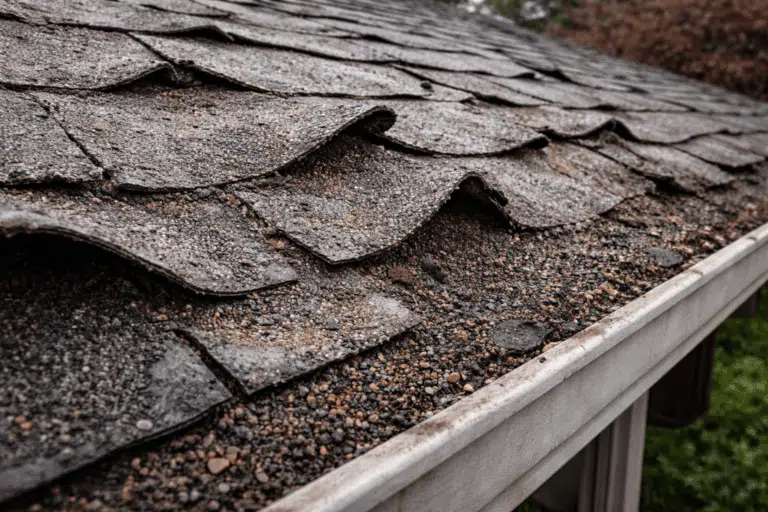
Asphalt shingles use embedded granules to protect the underlying asphalt from UV degradation. When you see significant granule loss — either as bare patches across the shingle surface or as heavy granule accumulation in your gutters — the shingles have lost their UV protection. This process is not reversible or repairable. Shingles in this condition are typically within 2–5 years of structural failure regardless of visible surface damage, and repair on top of them is money wasted.
Curling, cupping, or clawing shingles across the roof
Shingles curl in three ways: cupping (edges turn upward), clawing (edges lie flat but middle buckles), and curling (edges bend downward). All three indicate shingles that have aged past their performance window — the result of years of thermal cycling, moisture absorption, and UV exposure. When this appears across a significant portion of the roof, not just in one area, replacement is the only correct response. Nailing down curled shingles is a temporary cosmetic fix that doesn’t address the underlying degradation.
Sagging or soft spots on the roof deck
A visibly sagging roof or soft areas when you walk on the surface indicates structural damage to the decking — the plywood or OSB layer beneath the shingles. This can result from long-term moisture intrusion, rot, or in severe cases, structural rafter damage. A new layer of shingles over compromised decking is dangerous and will fail quickly. The decking must be replaced, which typically requires a full roof replacement in scope and cost.
Daylight visible through the attic
During a daylight inspection of your attic, you should not see daylight through the roof. If you do, those are gaps in the roofing system — points of water intrusion that can be occurring even when it’s not actively raining. Significant daylight visibility typically indicates sheathing gaps, damaged flashing, or shingle deterioration significant enough that replacement is warranted.
Homeowners who re-roof over damaged decking to save on tear-off costs. In Washington State, building code allows a maximum of two layers of shingles before a full tear-off is required. Installing a second layer over a roof with decking damage traps moisture, voids most manufacturer warranties, and typically leads to failure 3–5 years earlier than a clean installation. The tear-off cost you’re saving now becomes a larger problem — and a more expensive fix — later.
The Age Factor — The Single Most Predictive Variable
Of all the factors we look at during a roof inspection, age is the most reliably predictive. Here’s how it works in practice:
Repair is almost always appropriate for isolated damage. The roof has significant life remaining. Even a substantial repair is financially justified.
Evaluate the extent of damage carefully. Minor isolated damage may still be repaired. Widespread issues or multiple problems simultaneously — get a replacement quote before deciding.
Replacement is almost always the right call, even if the roof looks serviceable. Asphalt shingles have a functional lifespan of 20–25 years in PNW conditions. You’re near or past it.
In Western Washington specifically, the 20-year threshold is more conservative than in drier climates. Our wet winters, freeze-thaw cycles, and persistent moss growth accelerate shingle degradation. A 20-year-old asphalt roof in Seattle has been through significantly more stress than a 20-year-old roof in Phoenix — and it shows in inspection.
| Roof material | Expected lifespan (PNW) | When to start planning replacement |
|---|---|---|
| 3-tab asphalt shingles | 15–20 years | Year 15 — start budgeting |
| Architectural / dimensional shingles | 20–30 years | Year 20 — annual inspections critical |
| Metal roofing | 40–70 years | Year 35–40 — inspect fasteners and sealants |
| Cedar shakes | 20–30 years (with maintenance) | Year 20 — more aggressively in wet climates |
| Flat / low slope roofing | 15–25 years (material dependent) | Year 15 — inspect annually |
Cost Comparison — Roof Repair vs. Replacement in King County (2026)
| Scenario | Typical cost (King County 2026) | Right choice |
|---|---|---|
| Minor repair — flashing, few shingles, small leak | $300–$1,200 | Repair if roof is under 15 yrs |
| Moderate repair — section of shingles, localized decking | $1,200–$3,500 | Repair if roof has 10+ years remaining |
| Major repair — multiple areas, significant decking | $3,500–$8,000+ | Get replacement quote — likely better value |
| Full replacement — architectural shingles, standard home | $12,000–$22,000 | Replace if repair cost exceeds 50% of this |
| Full replacement — metal roofing | $18,000–$35,000+ | Long-term investment, 40–70 year lifespan |
The 50% rule: if your repair quote exceeds 50% of what a full replacement would cost, replacement almost always makes more financial sense. You’re spending half the money for a roof that still has the same age and the same remaining lifespan — without a warranty reset or a new system.
Pacific Northwest Factors That Shift the Decision
National roofing guides use averages that don’t reflect conditions in Western Washington. Here’s what’s different for homeowners in King and Pierce County:
Moss and algae accelerate degradation faster here
In Seattle and Bellevue, moss growth is nearly universal on untreated roofs. Moss root systems physically lift shingle edges, breaking the seal strips and allowing water infiltration at a much faster rate than in drier climates. A roof that might last 25 years in Colorado may reach end-of-life at 18–20 years here without regular moss treatment. If your roof has had visible moss growth for multiple consecutive years, assume its functional lifespan has been shortened.
Freeze-thaw cycles damage flashings and sealants more aggressively
Western Washington doesn’t get extreme cold, but freeze-thaw cycles — where temperatures drop below freezing overnight and rise above during the day — occur dozens of times per year. These cycles expand and contract metal flashings and caulk sealants, gradually breaking seals that are perfect candidates for localized leaks. If you’re seeing attic moisture or small drips during freeze-thaw weather specifically, flashing failure is almost always the cause.
Wind events are the most common source of sudden repair needs
The Pacific Northwest wind season runs October through March, with multiple significant wind events per year in King and Pierce County. Wind damage — missing shingles, lifted flashing, debris impact — is the primary driver of emergency repair calls we receive. Wind damage on a relatively young, otherwise sound roof is a legitimate repair situation. Wind damage on a 22-year-old roof is usually the event that makes replacement necessary.
Roof ventilation issues are more critical here than in dry climates
Inadequate attic ventilation causes moisture buildup in the attic space during our long wet seasons, leading to premature decking rot that isn’t visible from the exterior. Homeowners with recurring leak issues, apparent surface damage, and then surprisingly extensive interior damage when the roof is opened have almost always had a ventilation problem running in the background for years. Any comprehensive roof assessment in our climate should include an attic inspection.
What Homeowner’s Insurance Covers — And What It Doesn’t
This is where many homeowners have unrealistic expectations. The general rule in Washington State:
- Sudden, accidental damage is typically covered — wind damage, hail, a tree falling on your roof, fire. These events happen at a specific moment and are documentable.
- Gradual deterioration is not covered — general aging, moss damage, wear over time, deferred maintenance. Insurance covers events, not neglect.
- Age affects coverage — many insurance policies have reduced coverage for older roofs. A 20-year-old roof may be covered at actual cash value (depreciated) rather than replacement cost, meaning the payout covers far less than replacement actually costs.
If you have an older roof and you’re filing an insurance claim for storm damage, have a licensed contractor document the damage before the adjuster visits. Insurance adjusters assess what they can see — a licensed contractor who knows what to look for in PNW conditions can identify damage that an adjuster might not attribute to the storm event.
Quick Decision Checklist — Repair or Replace?
- Is the roof over 20 years old? If yes → strong lean toward replacement
- Is damage visible in more than one area of the roof? If yes → likely replacement
- Do you see granule loss across significant portions of the shingle surface? If yes → replacement
- Are shingles curling, cupping, or clawing across most of the roof? If yes → replacement
- Is there any decking rot or soft spots visible from inside the attic? If yes → replacement
- Has the roof been repaired more than twice in the past 5 years? If yes → replacement evaluation
- Does the repair quote exceed 40–50% of what full replacement costs? If yes → replace
- Do you plan to sell the home in the next 3–5 years? If yes → replacement has stronger ROI
If you answered yes to three or more of these questions, replacement is almost certainly the right decision. If you answered yes to one or two — and the roof is under 15 years old — repair is likely appropriate.
The most reliable way to get a definitive answer is a professional inspection by a licensed contractor who will go into the attic, assess the decking, and give you an honest assessment — not just a quote for whichever service they think you’ll buy. Our team provides free roof assessments throughout King and Pierce County, with a written summary of what we found and our recommendation before any commitment.
Not sure if your roof needs repair or replacement?
Orca Roofing & Exteriors has been serving King and Pierce County homeowners for 6 years. We provide honest, no-pressure roof assessments — we’ll tell you exactly what your roof needs and what it will cost, before you decide anything. Learn about our roof replacement services → or roof repair services →
FAQs — Roof Repair vs. Replacement
How do I know if I need a roof repair or a full replacement?
The two key factors are the age of the roof and whether the damage is isolated or widespread. If the roof is under 15 years old and damage is limited to one area with a clear cause, repair is typically the right call. If the roof is over 20 years old, damage appears in multiple areas, or repair costs exceed 40–50% of replacement cost, replacement is almost always the better investment.
How much does roof repair cost vs. replacement in Seattle and Bellevue?
In King and Pierce County in 2026, minor roof repairs run $300–$1,200, moderate repairs $1,200–$3,500, and major multi-area repairs $3,500–$8,000+. Full roof replacement for a standard home with architectural shingles runs $12,000–$22,000. If your repair quote is approaching $6,000–$11,000, get a replacement quote before proceeding — the math often favors replacement.
How long does a repaired roof last?
A targeted repair on a structurally sound roof in good condition can last the remaining life of that roof — 10–15 years if the roof is in its mid-life. A repair on an aging or degraded roof typically holds for 2–5 years before the underlying aging catches up. The condition of the surrounding roofing system determines how long any repair will perform, not the quality of the repair itself.
Is roof repair worth it on a 20-year-old roof?
In most cases in the Pacific Northwest, no. A 20-year-old asphalt shingle roof in Western Washington has experienced significant stress from our wet winters, moss growth, and freeze-thaw cycles — often more equivalent to a 25-year-old roof in a drier climate. Unless the repair is minor and the rest of the roof passes a thorough inspection, you’re typically delaying an inevitable replacement while spending money that could go toward it.
Does homeowner's insurance cover roof repair or replacement?
Insurance covers sudden, accidental damage — wind, hail, impact, fire — but not gradual deterioration, aging, or deferred maintenance. In Washington State, older roofs may be covered at actual cash value (depreciated) rather than replacement cost, which can mean a significantly lower payout. Have a licensed contractor document damage before the insurance adjuster visits, especially for storm-related claims.
Can you repair a roof instead of replacing it?
Yes — and in many cases, repair is the right financial decision. Isolated damage on a relatively young, structurally sound roof should be repaired. The mistake most homeowners make is repairing a roof that has systemic aging issues — spending $2,000–$4,000 on a roof that needs full replacement within 2–3 years anyway. A professional inspection that includes the attic and decking, not just the visible surface, is the only reliable way to distinguish a repair situation from a replacement situation.